How to build a self-study roadmap when no teacher is there to tell you what to do next
The fastest way to waste a month is to start collecting resources before you know what you’re trying to finish. A better self-study roadmap starts with one clear outcome, then works backward into milestones, practice, and weekly checks. If you’ve been asking yourself how do i create a self-study plan without turning it into a pile of random notes, this is the part that makes the rest easier.
Start with the outcome, not the resources
Most people begin with the easy part: videos, books, courses, bookmarks. That feels productive, but it often creates a self-study routine that sticks only in theory.
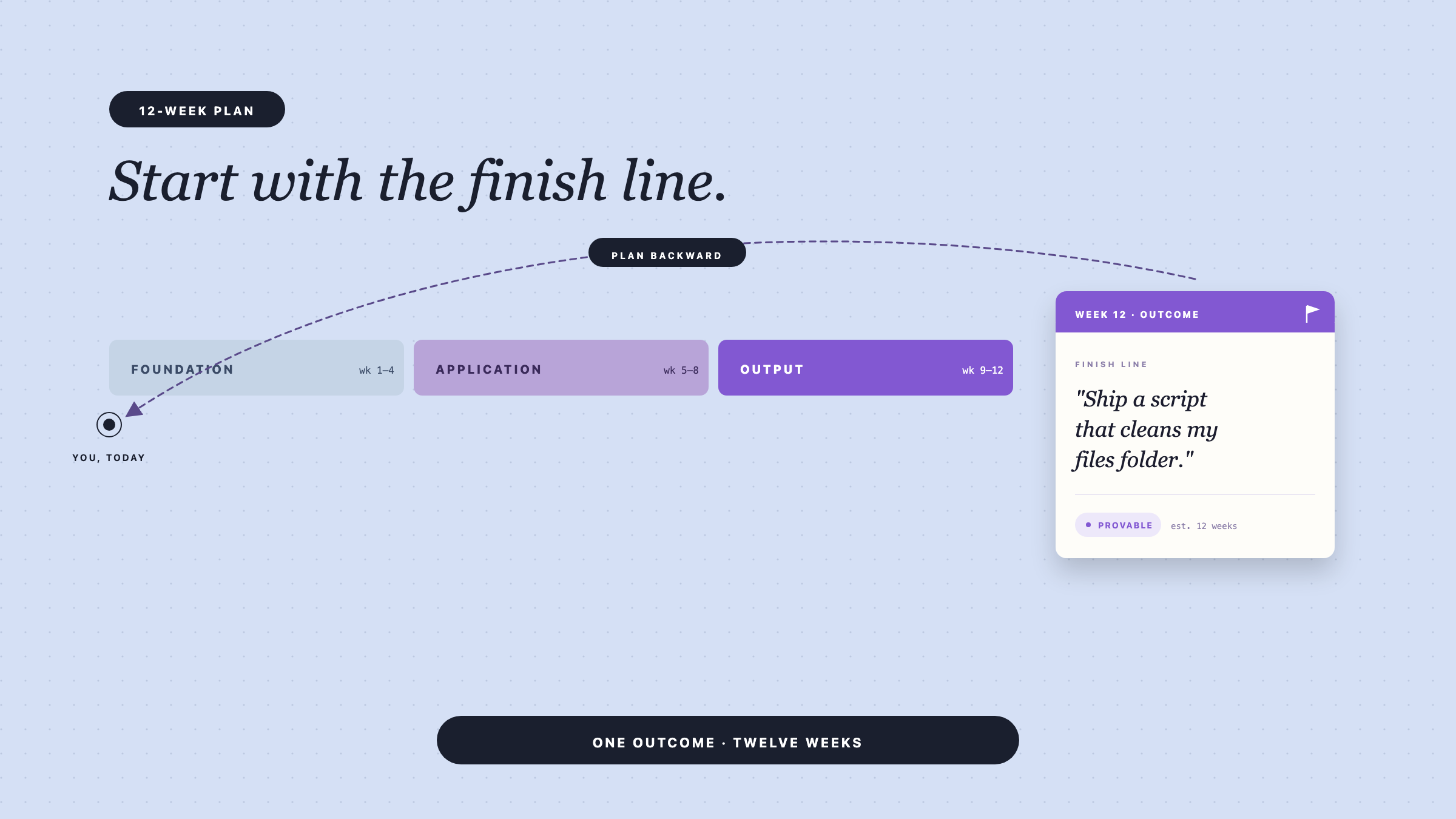
Start with a finish line you can describe in one sentence. Not “learn Python.” Try “build a small script that cleans up files” or “pass an intermediate Spanish speaking check.” The point is to make the goal visible enough that you can tell when you’re moving.
Then add a time box. A 12-week window works because it’s long enough to make progress and short enough to keep urgency. You don’t need forever. You need the next useful target.
If you’re wondering how to self-learn a subject without getting lost, this is the first rule: define the result before you define the materials.
How to break a subject into milestones
A blank topic feels huge because it is huge. The fix is not more motivation. It’s slicing the subject into smaller wins.
Think in three layers:
- Foundation: the core terms, tools, and concepts you need just to stop feeling lost.
- Application: the first real tasks that prove you can use the idea.
- Output: a project, test, presentation, or piece of work you can point to.
For example, a beginner in data analysis might move from spreadsheets, to formulas and charts, to a short report built from messy data. A language learner might move from basic vocabulary, to short speaking drills, to a 2-minute self-introduction recorded without notes.
That’s the shape of a study plan without teacher guidance. You’re not guessing your way through a subject. You’re building a sequence.
If you need a shortcut, write your milestones as questions:
- What do I need to understand first?
- What should I be able to do by week 4?
- What proof will show I’ve reached the goal?
The last question matters most. A roadmap without proof turns into a mood board.
Choosing resources without overload
Resource overload kills momentum. Three decent sources beat thirteen half-used tabs.
Pick resources by job, not by reputation. One source should explain the basics. One should give worked examples. One should force practice or output. That mix covers most self-learning roadmap needs without turning your browser into a landfill.
Use this simple filter:
- Does this resource match my current level?
- Does it help with this milestone?
- Will I actually use it this week?
If the answer is no to all three, skip it.
A lot of learners think they need the “best” resource. They usually need the next resource. The one that helps them complete the next milestone matters more than the one everyone recommends in a forum thread.
This is also where people over-plan. They spend two hours comparing resources for a subject they haven’t practiced once. Don’t do that. Your first resource set should be good enough, not perfect.
Scheduling practice and review
A self-study routine that sticks needs two kinds of work: learning and recall.
Learning time is when you read, watch, or listen. Recall time is when you try to use the material from memory. That second part is where progress shows up.
Set a daily learning block that fits your life. If you only have 20 minutes, use 20 minutes. A small, repeatable block beats a heroic plan you abandon by Thursday.
Then add review on a fixed rhythm. Spaced review - revisiting material right before you forget it - is one of the most studied learning techniques because it works. You don’t need a fancy system to use it. Just return to older material on a schedule instead of waiting until you feel rusty.
A simple weekly pattern looks like this:
- Mon–Thu: learn and practice one new chunk.
- Fri: do a mixed review.
- Weekend: complete one larger task or project step.
If your subject is skill-heavy, use more practice than reading. If it’s concept-heavy, keep short explanations and make the recall work harder. The balance changes by subject, but the rule stays the same: exposure alone doesn’t create skill.
How to know if your plan is working
You don’t need a complicated dashboard. You need signs that your plan is producing output.
Track three things:
- Time spent: Did you actually show up?
- Milestone progress: Did you finish the week’s target?
- Sticking points: What keeps breaking your flow?
If you can’t name the bottleneck, you can’t fix it. Maybe your goals are too big. Maybe your resources are too dense. Maybe you need more practice and less passive study.
A good self-study plan gets easier to follow, not harder. If each week feels like a scramble, your roadmap is probably too vague or too ambitious.
One useful test: can you explain your plan to someone else in under a minute? If not, you likely have too many moving parts. A clean plan sounds boring when you say it out loud. That’s usually a good sign.
The best adjustment is simple: shrink the scope, keep the outcome, and reset the next two weeks. Don’t scrap the whole roadmap because one piece stalled.
A plain way to turn a blank subject into a plan
If you want a quick decision tree, use this:
- Pick one outcome you can finish in 12 weeks.
- Break it into 3–5 milestones.
- Choose one basic resource, one example source, and one practice source.
- Set a short weekly learning block plus one review block.
- Define what success looks like at the end of each week.
That’s enough to start. It won’t look impressive in a notebook, and that’s fine. A real plan earns its keep by helping you decide what to do next when you’re tired, busy, or stuck.
If you want help turning a topic into a real roadmap, Draft and Arc can draft a 12-week self-study plan with milestones, practice tasks, and weekly checks from a single prompt.